State of Disaster Philanthropy 2025: Leveraging philanthropy’s strengths to maximize impact

Today, the Center for Disaster Philanthropy (CDP) released the 12th edition of the State of Disaster Philanthropy (SODP), which explores 2023 giving and practices, how philanthropy is responding to current changes and uncertainty, and strategies to strengthen disaster philanthropy.
Key findings
 In 2023, the Maui wildfires and the Turkey-Syria and Morocco earthquakes dominated headlines, affecting millions of people and destroying thousands of homes and businesses. How did philanthropy respond? The research found that in 2023, of the $135.3 billion in philanthropic giving, according to Candid’s database, $1.2 billion, or 0.9%, went toward disasters. Based on the scale and intensity of disasters and crises, more philanthropic investment is needed to strengthen affected communities.
This year’s edition of SODP calls on philanthropy to leverage its resources and strengths to do more both when a disaster occurs and, critically, beforehand. A consistent theme CDP has observed over the years of producing SODP is the significant funding for response and relief.
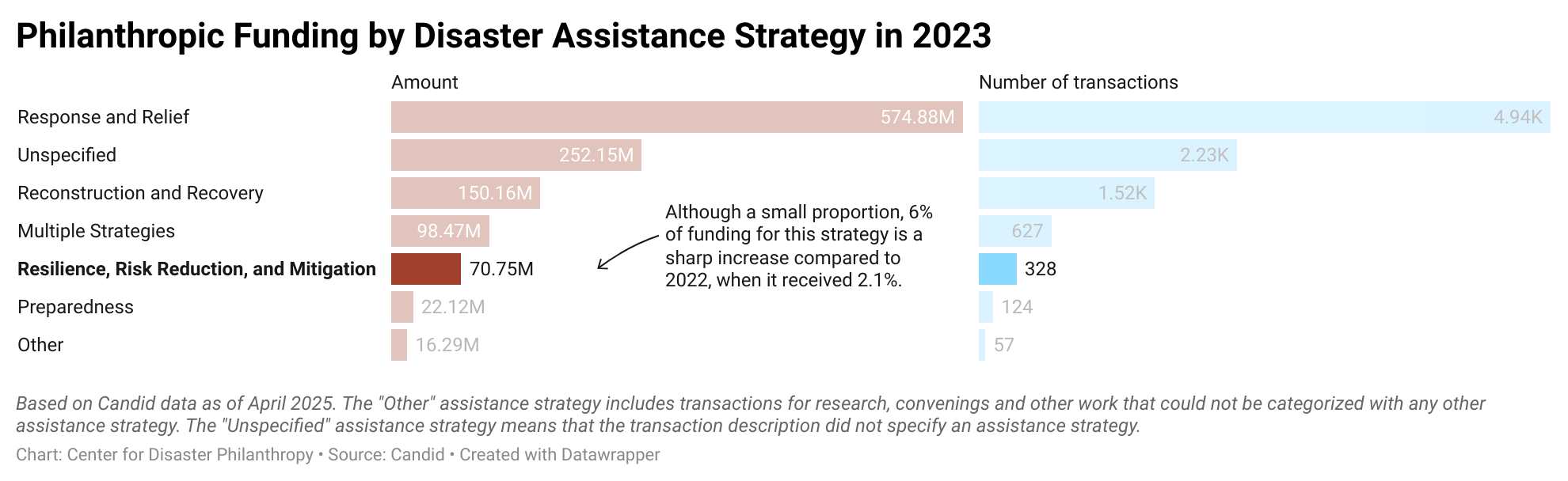
When examining how and where philanthropy focused its support for disasters, we see that among disaster assistance strategies, response and relief continued to receive the most funding and the highest number of transactions in 2023.
In addition to supporting immediate needs following a disaster, donors can have a lasting impact by helping communities prepare for disasters before they occur. The United Nations Office for Disaster Risk Reduction references studies showing that $1 spent on disaster risk reduction delivers an average return of $15 in terms of averted future disaster recovery costs. From the giving data and through interviews with philanthropic leaders, we see philanthropy recognizing this importance.
Although it represented only a small proportion of funding across disaster assistance strategies in 2023, resilience, risk reduction and mitigation saw an encouraging threefold increase in the share of funding compared to 2022.
Insights from philanthropic leaders
To complement the data on philanthropic giving for disasters and to better understand how the field is responding to changes and uncertainty, as well as the strategies being used, we spoke with leaders from 16 organizations worldwide.
The data from this additional effort helps to round out the quantitative data and give it more color. It also highlights some trends in the current state of philanthropy. One of the more insightful and common themes to emerge in conversations with leaders was that philanthropy should avoid reactively focusing exclusively on what is happening now and instead maintain a more proactive, long-term view.
This aligns well with one of philanthropy’s strengths – flexibility to think long-term, which has implications for where and how support is provided and for what purpose. What we heard from philanthropic leaders based in the U.S. and in other parts of the world is that in practice, this can look like investing in preparedness ahead of a disaster, addressing underlying vulnerabilities and strengthening community resilience:
- “Preparedness and resilience, that’s where we see less funds. I would like to see more philanthropic capital in that area because that’s harder for governments to justify, especially because governments have a time span, and they want to see short term results.”
- “How do we shift that paradigm so that, yes, we are responding to the acute immediate needs, but how are we also investing in the systems and infrastructure that need to be more resilient for the long term?”
- “I think disaster philanthropy needs to get bigger, and it needs to evolve from just responding to resilience, in the coming years.”
- “Philanthropy plays a unique and critical role in both the immediacy of disaster response and the longer-term process of recovery and resilience building.”
Recommendations for philanthropy
Philanthropy is almost always involved in reducing vulnerabilities, regardless of the explicit focus. Whether donors are engaged with health equity, education or food security, a long-term view helps shift the focus from exclusively meeting today’s basic needs to planning for how to reduce vulnerability, strengthen community resilience and prepare for when the next crisis does occur.
In this year’s edition of SODP, we provide three ways donors can leverage their strengths to do more with communities both when a disaster occurs and critically beforehand. One of the three is to address immediate disaster needs, but always take a long-term view.
Yes, it is important to show solidarity by providing philanthropic support when a disaster occurs, and funders are uniquely positioned to contribute over the long term to ensure the next disaster or crisis is less harmful.
For more data, insights and recommendations for the field, including strategies for strengthening disaster philanthropy practice, I invite you to explore SODP 2025.
Austin Snowbarger
Director, Strategy and Research