What we’re watching: Weekly disaster update, December 8
Here’s what we’re watching for the week of Dec. 8, 2025.
New or Emerging Disasters
Earthquake – Japan: A magnitude 7.6 earthquake struck the northern coast of Japan on Monday, Dec. 8, injuring at least 23 people and triggering a tsunami of up to 28 inches. Residents were told to seek higher ground.
At least 800 houses lost power in Iwate Prefecture, and fires and power outages were reported in Hachinohe City.
Wildfire – Australia: Temperatures as high as 104 degrees F combined with high winds caused a wildfire in Koolewong, a town north of Sydney, on Dec. 6. The fire damaged or destroyed at least 18 homes, and one firefighter was killed.
In Tasmania, at least 20 homes were destroyed by a wildfire this past weekend. No injuries were reported.
Previous/Ongoing Disasters
Cyclone Ditwah – Sri Lanka: At least 480 people died from Cyclone Ditwah, which struck Sri Lanka in late November. One million people were affected (representing almost 320,000 families), at least 25,000 homes were destroyed, and more than 200,000 people are staying in government-run shelters.
The damage to the rest of the country has been severe. Less than one-third of the 1,000 miles of rail lines in the country remain operational.
According to the New York Times, “The more than 137,000 acres of land that have been destroyed by the floods, along with wrecked dams and canals, have inflicted a heavy economic toll just weeks after rice paddies had been planted.”
Officials estimate that the cost of rebuilding all that was lost in the storm will be between six and seven billion USD.
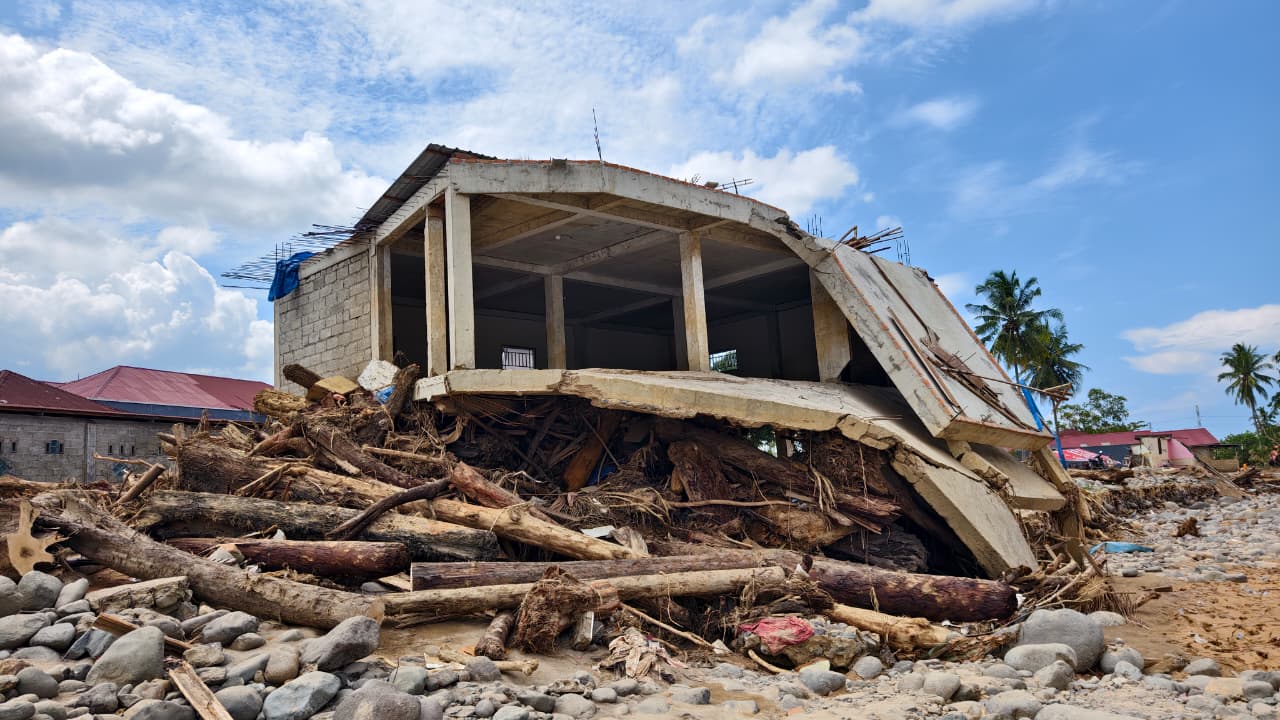
Flooding – Indonesia: At least 950 people have died, and 274 are missing in Indonesia after Cyclone Ditwah and weeks of devastating rains in November triggered catastrophic flooding and landslides. More than 5,000 people were injured, and many communities remain cut off from aid and services due to destroyed bridges and roads.
Transmission towers collapsed, causing internet outages and plunging entire communities into darkness. With wells and pipes destroyed, people are forced to drink the same muddy water that flooded their homes, resulting in illness.
Many people blame deforestation and government corruption for the scale of the disaster, and more monsoon rains are expected this week.
Complex Humanitarian Emergencies – Myanmar
When a country experiences political conflict, climate shocks, famine, economic challenges or other conditions, it may suffer a complex humanitarian emergency (CHE). CDP maintains complete profiles on several CHEs. Every week, we highlight these and other CHEs, hoping to build awareness and increase philanthropic response.
We are currently focusing our CHE updates on violence against women and girls (VAWG). Political upheaval exposes women and girls to a high risk of violence as parties to the conflict fight for power. This crisis of violence often looks similar around the world, even though the cultural and political contexts might be different. VAWG notoriously receives very little funding, despite being a pervasive and urgent problem affecting millions of women and girls.
The crisis of violence against women and girls in Myanmar is severe and worsening, driven by a military coup, displacement, and the collapse of health services and the rule of law. Women and girls face extreme risks of torture, sexual and gender-based violence (GBV), arbitrary detention, forced conscription, trafficking, and domestic abuse, with almost no access to protection or justice.
Key facts:
- In detention and interrogation centers, military forces as well as non-state armed groups frequently use sexual and gender-based violence as a form of torture, including rape with objects, burning of genitals, sexual humiliation and invasive body searches. Women are subjected to prolonged stress positions, electrocution, beatings and deprivation of food and water.
- Units like the “ogre column” in Sagaing Region have been documented abducting, beheading, maiming and raping women.
- Since the 2021 coup, at least 27,500 people have been arrested, including over 5,700 women and 570 children. More than 1,900 have died in custody.
- Military authorities also use abductions and detention of family members to enforce conscription, including of women and girls, who are then used as porters and human shields. There are verified reports of the military recruiting and using over 1,100 children in 2023, including girls, in combat and support roles.
- Domestic violence has increased sharply due to stress, economic hardship and displacement. With the collapse of health and justice systems, few women can report abuse or obtain medical care, forensic support or protection orders.
- Rohingya women and girls in Rakhine State face extreme risks amid renewed conflict. Women with disabilities and older women are at particularly high risk of GBV in shelters and receive very little targeted funding. Women human rights defenders, activists and journalists are also specifically targeted for their opposition to the junta.
- Humanitarian aid, including GBV and sexual and reproductive health (SRH) programs, is deliberately blocked by the junta as a method of collective punishment, leaving millions without protection or medical care.
Funding for lifesaving GBV and women’s protection programs remains critically short, threatening the closure of safe spaces and support services for survivors. Around 10.4 million women and girls in Myanmar need urgent humanitarian assistance.
What We’re Reading
- See Which New York City Neighborhoods Could Get Hit By the Next Hurricane – The New York Times
- Sea level doesn’t rise at the same rate everywhere – we mapped where Antarctica’s ice melt would have the biggest impact – The Conversation
- GivingTuesday raises $4 billion, up 13 percent from 2024 – Philanthropy News Digest
- As FEMA Falters, Philanthropy Is Forced to Step Up – Chronicle of Philanthropy
A moment of hope… Two years ago, Romania launched the world’s largest deposit-return system for recyclables. Since then, the country has achieved a remarkable 94% recycling rate for beverage containers. The public-private program incentivizes consumers by charging a small deposit on bottles and cans. When the items are returned, the deposit is refunded, and consumers also receive an additional bonus.
Unburdened by legacy systems, this innovative approach to recycling has quickly made Romania a leader in Europe, surpassing countries traditionally recognized for their strong waste management.

Gina DeLuca
Content Development Associate