“We didn’t have anywhere else to go,” said Rhonda Hollifield, a kinship caregiver in Western North Carolina. “The foundation was washed out, the dining room floor was buckled. We carried water from the creek to flush the commode.”
Kinship caregivers are usually relatives, family friends or neighbors who step in to raise children when their parents are no longer able to care for them, forming a kinship family. Kinship caregivers are often grandparents living on fixed incomes, making it difficult to afford emergency supplies, food or temporary housing after a disaster. Some also face barriers to accessing disaster assistance because kinship arrangements are not always recognized by traditional relief systems.
In September 2024, Hurricane Helene ravaged Southern Appalachia, particularly Western North Carolina, when catastrophic rainfall caused flooding and landslides throughout the region. In some areas, entire roadways were washed away in the floods. Communities lost internet and telephone access for weeks, making it extremely difficult to reach out to loved ones or seek support at the height of the disaster.
For families already navigating the complexities of kinship care, the storm created even greater uncertainty.
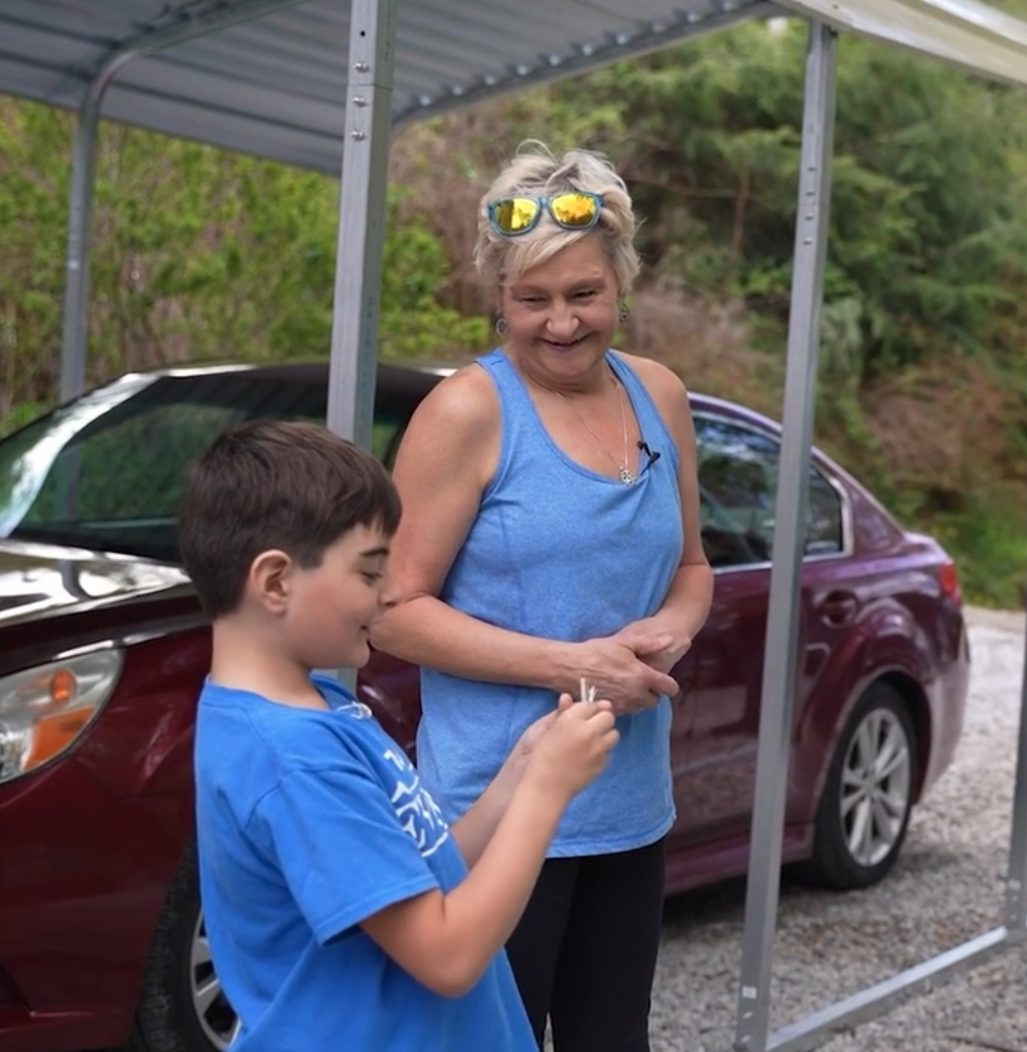
Rhonda Hollifield knows these challenges well. She took in her grandson, Elijah, after his mother, who was struggling with addiction, could no longer care for him. Like many kinship caregivers, Rhonda worked hard to create a stable, loving home for her grandson. Damages to the Hollifields’ home caused by Hurricane Helene suddenly put that stability at risk. Like many people in the region, the Hollifields continued to live in their house without electricity, heat or running water, and with warped structures and rapid mold growth after the storm because they had nowhere else to go.
“I was worried all the time that the Department of Social Services was going to show up and say I couldn’t have Eli in the home [due to the damage]…but I didn’t know what else to do,” said Rhonda.
Thankfully, High Country Caregivers (HCC), a nonprofit focused on supporting kinship families in Western North Carolina, acted quickly to reach families in the days after the storm.
HCC mobilized staff and volunteers to check on all 213 kinship families it serves across six counties. Teams delivered food, fuel, emergency supplies and essential gear, traveling back roads in four-wheel-drive vehicles and hiking into areas made inaccessible by flooding and landslides to ensure every family was reached. That early response became the first step in helping families like the Hollifields begin the long road to recovery.
With a $370,000 grant from the Truist Foundation Western NC Recovery and Resiliency Fund, High Country Caregivers is helping kinship families move beyond emergency response toward lasting recovery.
So far, the funding has supported the construction of two resilient, weather-resistant homes built to improved safety standards and provided families with navigation services, temporary housing, household essentials, food and water access, referrals to community resources, and no-cost mental health support. Together, these efforts reduced the risks of displacement and environmental health hazards while helping children remain in stable, loving homes with their relatives.
“These families need to be able to focus on raising their grandkids, not on whether their heater will last through the winter,” said Ginger Laws, the Pathways to Success and Special Projects Coordinator for HCC. “We wanted to give them hope. As long as somebody has hope, they’re not going to give up.”
At CDP, we know that helping families find stability again is essential to recovery. High Country Caregivers’ whole-family approach recognizes that homes provide more than shelter; they offer space for children to grow, caregivers to breathe a little easier and families to build new memories together after disaster. We are proud to support HCC and the work they do to help families heal and move forward together.
“This is more than I could have ever imagined, what they’ve done,” said Rhonda. “Just knowing there’s no mold in it; you can walk across the floor and don’t have to worry about falling through it. I mean honestly, people take that stuff for granted. Thank you seems so inadequate.”
Learn more about High Country Caregivers and the Hollifields in the video below: